7.27.2011

Own Your Own Piece of the Internet for Only $185,000

The Internet Corporation for Assigned Names and Numbers (that's ICANN to you), just voted to extend the possibilities for domain extensions to absolutely anything – provided you can pony up the cash and prove that you have a legitimate claim to the name.

To avoid any confusion, what we're talking about is the part of an internet address after the dot. For example, .com, .gov, .uk, or any of the 22 suffixes that appear in a URL. Now a company is free to put their own stamp on their address and, assumably, sells domains with that extension. Cannon, Unicef and Paris (the city, not the heiress) have already expressed their intentions to purchase their own names.

To avoid the hijacking that happened in the '90's, they’ve implemented a policy of reviewing every application to make sure the organization has a legitimate business plan and a legal claim to the dot name. If more than one company wants the same name, it will go to auction where the highest bidder wins. Any Joe-off-the-street cannot purchase a dot name unless he provides business details, which is meant to stop people from hoarding names for resale.

This is pretty exciting news for anyone who's ever tried to find a decent domain name. Websites are so important to a business' livelihood that it's not an uncommon practice to wait to commit to a new business name, until you've seen what domains are available. This has led to some pretty crazy names. Luckily, alternate dot names have been gaining acceptance which should help us move away from creating unintelligible business names, just to secure an unused dot com.

The Move to Alternate Domains


The website Good is an example of this move. Their URL– good.is –says more about their mission statement than any other address could. The premise of their business is spreading the word about acts of goodness throughout the world, especially in sustainability, human rights and culture. Their domain is their mission: Good Is.... The website itself answer the end of the sentence.

Here are few other examples that add meaning to the domain name:

• Connect.me: a service that manages all of your social media.
• Aquent.us: more relevant because they have offices in other countries. The .us moniker is becoming very popular.
• CentralCoop.coop: too bad for them someone already owns central.coop because it would be even better without the redundancy.

Not only do alternate domains provide a way to bring more meaning to your web address, it helps that there isn't as much competition so acquiring a concise and appropriate name is easier.

The Google Effect

In the end, it probably doesn't even matter what your domain name is. Browsers have become more like cell phones in that there's almost no reason to remember a URL anymore. Between the auto-fill in the address bar, the integrated search bar and the advanced bookmarking capabilities of modern browsers, it's possible to find anything you want without ever knowing the address. More than ever, the domain name is less important than communicating relevant information about your company, so the audience can Google you when it's convenient for them.

The question is: if the name you want is not available as a dot com, is it better for you to select an alternate dot name or pick a dot com that is too long, or doesn't really describe your business? There's no one-size-fits-all answer, but the more options we have, the more likely it is that you'll find something that works for you. Or hey, if you've got an extra $185K lying around, you might want to spring for your very own dot name. Now wouldn't that be fun?

7.21.2011

New Banners For The Bravern

We just finished installing banners for the residential towers at The Bravern in Bellevue. These beauties allow light to pass through so the interior corridors remain well lit, while the banners appear opaque from the exterior.

7.19.2011

Google Adword's Most Expensive Keywords


Ever wonder what the most competitive terms are for the text ads that appear next to your search results in Google? Those ads, known as Adwords, are a highly lucrative business for the search company and account for 97% of their $33.3 billion in revenue. But who are the biggest bidders? Check out this great infographic by WordStream for the details.


Click here to see a larger version of this graphic.

7.05.2011

The Results Are In!

“I can’t thank you, and your team, enough for all the work that has been put into “improving” our site. From the first meeting with your team I knew that we would be able to accomplish our goal. You really do have an extraordinary group of people working with you. Carolyn and Holly were great to work with – professional, responsive, and truly know their stuff. The site is so much more exciting and dynamic now! Thank you!”

Carol Lobaito
Director of Sales & Marketing
The Arctic Club Seattle - a DoubleTree by Hilton


The e! team was selected by The Arctic Club Seattle, a DoubleTree by Hilton Hotel, to enhance the performance of their Dome Room website. The Dome Room is one of Seattle’s premier venues for weddings and events. However, the Dome Room’s website would rarely show up in search engines, severely limiting sales opportunities.

We met with Carol Lobaito, Director of Sales and Marketing for The Arctic Club Seattle, to discuss their big-picture goal of increasing site visitations through search engine optimization (SEO). Through careful analysis, we developed an SEO strategy that was customized specifically to meet their goals. Our plan took into account the site as a whole, with consideration for their desired demographic. Our approach included optimizing site content and site structure, plus catering to a wider variety of devices including mobile devices.

Previously the top keywords used to find the Dome Room website were specific to the hotel and the venue. By casting a broader net, the website can be found through a wide range of keywords that are likely to be searched by potential customers and people unfamiliar with the property. This has given The Arctic Club Seattle the opportunity to reach a wider audience and be much more competitive with other venues in the region.

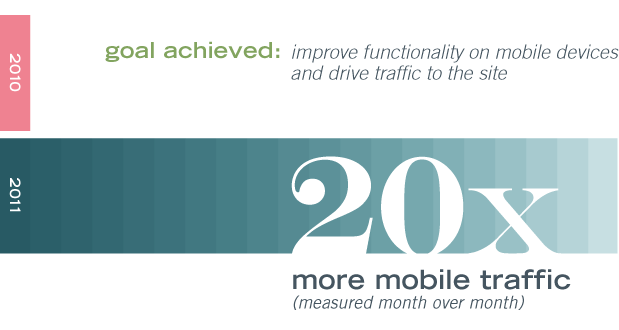
The result was a dramatic increase in site traffic.
Results are measured month over month

The overall increase in traffic was 320%


Search engine referrals increased by 825%

Mobile traffic increased approximately 20 times over, or by 1,995%

If your website would benefit from an increase in website traffic and search engine optimization, you should contact the e! team today.

Click here to visit The Dome Room website.

Looking Good In Grandview


Effective Design Studio was selected by the City of Grandview in eastern Washington to design their new gateway sign and banner program, as part of a city-wide beautification program.

Through a design process that included a charrette with city officials, we explored several design directions, taking into account culture and heritage, structure, wind load factors, lighting, and materials.

The final designs incorporate the city’s logo and agricultural themes that are the heart of this community. This project was a grassroots effort by the city, which engaged many of the residents, city council and prominent businesses in the design review process. Once given options, they were quickly able to decide on the final design. Dedication for the whole beautification project was May 12, 2011.


High Style for a High Rise Collateral System


With heightened competition in office leasing, Beacon Capital moved to maximize their lease conversion ratios. To successfully achieve this goal, they brought in Effective Design Studio to design a new marketing collateral system for their West Coast portfolio, which consists of Class A buildings and landmark properties.

Effective Design Studio collaborated with the client and the leasing teams for each property to review their research and utilize their experience to develop a distinctive voice for all marketing communications. e! designed powerful graphic elements including maps and plans, and presented a 2-tiered collateral system to embrace the breadth of their portfolio of properties. The final result showcases their world-class portfolio in enduring style.

Visit our project profile for more photographs.

5.20.2011

CNN reads the e! blog

A few months ago I wrote about the enormous potential I see for the future development of the iPad. For those of you who haven't read the post, I'll summarize. That device has changed my expectations for the web. It seems that tablets have created a platform that is satisfying on more levels than a simple desktop or laptop computer. Up until now, the experience of using the Internet instead of traditional print materials has been an exercise in give and take. Sometimes better, sometimes worse. It's easier to find information and there's much more of it, but we've been forced to accept a degraded level of enjoyment, satisfaction and ease of use.

In my article, I compared CNN.com's home page to that of the Daily Beast. CNN is simply a list of headlines, similar to a table of contents and not any more interesting; The Daily Beast is buffet of visual information organized into a clear hierarchy which uses images to quickly communicate. Quality of content aside, these are two totally different approaches to delivering the news.

A few weeks ago, CNN launched a beta version of what they're calling their Tablet View which is a version of the site that is re-imagined to present the news in a more visual way. The articles are presented with an image and headline, arranged from most important in the larger column on the left to least important in the smallest column on the right. When you select a story, it pops up and allows you to read a portion of the article, click through to the full story, or go to the next one.

For those of you familiar with Flipboard, Taptu or The Daily, you'll notice that CNN's tablet view has taken a page out of their book. One of the significant features of these apps is their ability to give you a quick idea of an article without bogging you down with too much content, until you're ready to commit. It reminds me of the front page of a traditional newspaper. Short blurbs of multiple articles, and you have to turn the page to finish reading. Flipboard does this perfectly and it also allows you resize and organize these articles within your board (see a video of this in action). Why did we have to come so far to return to a concept that has been in use for decades?

The CNN version is still in beta, and you can tell. It appears they tried to implement a new system without considering if the content will actually work in the new layout (one stock chart would be more than enough, thank you very much). The design and implementation is not in the same league as Flipboard or the other apps, and I would guess CNN developed this as a proof of concept, not a fully-fleshed out design. If not, CNN please give me a call. We need to talk.

The significance in CNN spending resources to investigate this approach is that it validates the idea of a paradigm shift in our expectations for web-based experiences, and therefore what we as designers/developers need to consider. It seems the collective expectation is that everything should be more interactive -- or experiential -- and offered to us in a manner similar to the offline world. And we are just now becoming capable of delivering on that demand. Just imagine if you walked into Barnes & Noble to buy a magazine and they simply handed you a list of titles and didn't allow you to browse through the covers with their beautiful, glossy photos and flashy headlines. Would you buy anything?

As humans we're susceptible to the emotions brought on by images and colors. Over the years we've grown to crave this stimulus and the online world has struggled to deliver that emotional payload, and has suffered for it. Online advertising rarely garners the prices that print ads command. This shift represents a move toward a more emotional, and therefore satisfying, experience on the web. I believe this will usher in a new era where you can find multi-sensory experiences through technology that are as satisfying as their tangible, offline counterparts. It might not happen overnight, but I feel like we now know what we've been working towards.